
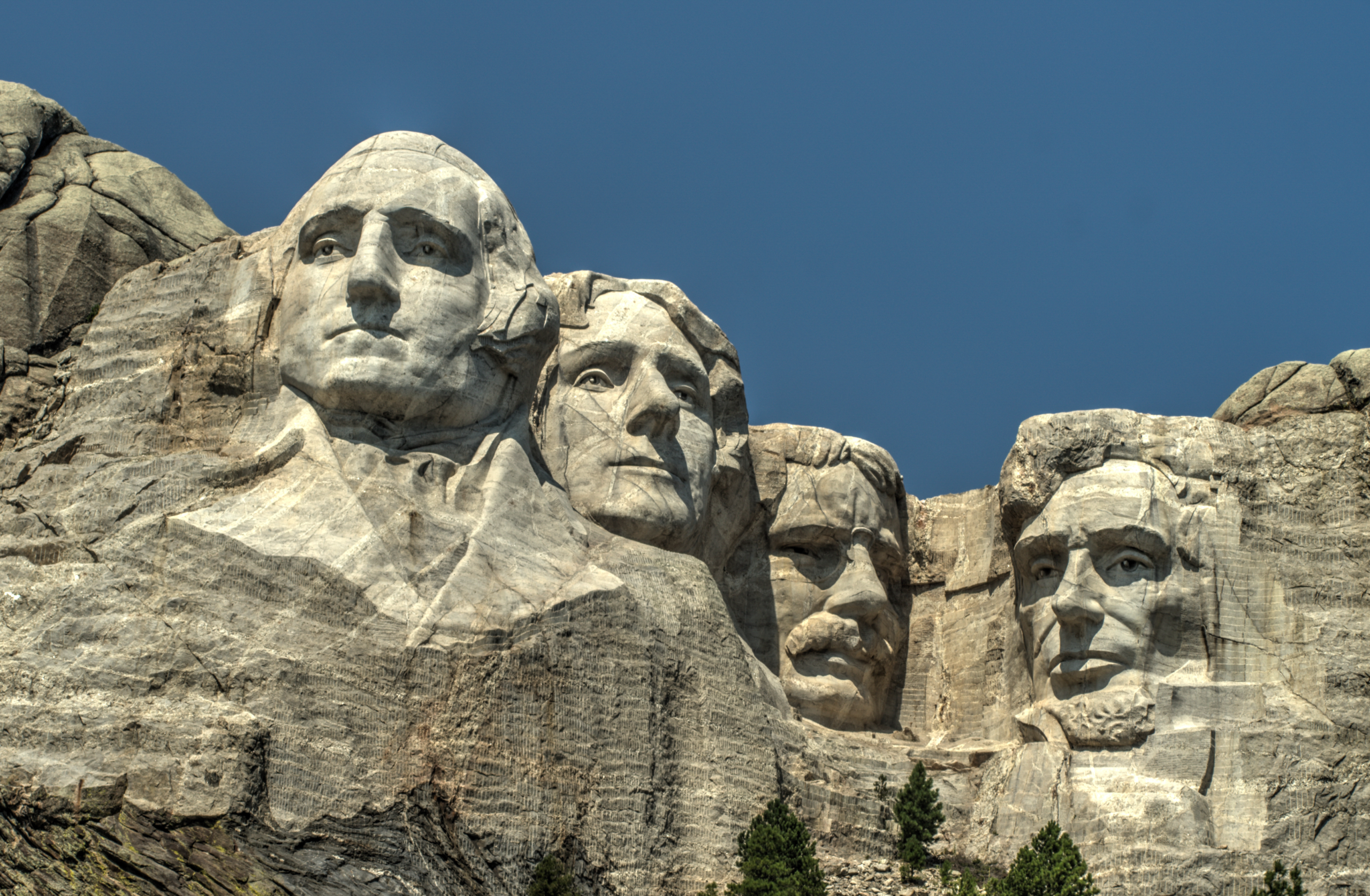
Presidents’ Day is, officially, the birthday of George Washington, the First President of the United States. Considering this underappreciated holiday, it only seems right to put together a list of the top ten presidents in American history. Presidential rankings are usually exercises in nostalgia, ideology, or partisan loyalty. They tend to reward rhetoric, symbolism, emotion, or modern political fashions. Rarely do they ask the harder question, that being which presidents actually strengthened the American state, preserved its legitimacy, and guided it through moments when failure was a real possibility.
This list is built around that question. It is less concerned with personality than with performance, and cares less about intentions than outcomes. The best American Presidents have consistently understood three key virtues: power, restraint, and responsibility, and many embodied these virtues at moments when the republic could easily have fractured. Their greatness is not in personal or political perfection, especially by the standards of modern moralistic liberalism. However, each of these great men, in different ways, helped ensure that the United States remained a coherent, stable, institutionally viable, and self-governing nation.
1. George Washington
Of course, there is simply no other figure to crown the best president in American history, because Washington was the very man who rejected the crown. Washington could have taken dictatorial power following the victory over the British in the American Revolution, however he resigned from his military post and retired to his estate in Mount Vernon. King George III said of Washington, upon hearing this as a rumor prior to its happening, that if Washington did retire, “…he will be the greatest man in the world.”
Even after Shay’s Rebellion and the instability of the Articles of Confederation, Washington could have made the Presidency a lifelong appointment as Alexander Hamilton had hoped, or established himself as a Caesar of sorts as Napoleon later would in France. Instead, he established the principle that authority in America would be temporary, limited, and subordinate to institutions. His personal example created legitimacy for the entire system. It made the presidency legitimate before it was powerful, rather than powerful before it was legitimate. He taught Americans that power could be exercised firmly without becoming tyrannical, and every successful transfer of power since Washington traces back to his decision to step away. Just as important as his resignation was his insistence on political neutrality and constitutional order. Washington’s Doctrine of Unstable Alliances was a template that was unfortunately abandoned in the 20th Century, but, in its day, prevented the young republic from being dragged into European power politics.
2. Theodore Roosevelt
Beyond the creation of the National Parks System, his expansion of American power, his negotiation of the Russo-Japanese War, and his mighty, larger-than-life personality, the Bull Moose understood that a modern industrial nation could not survive on 18th century minimalism. He believed the presidency had to be energetic, capable, and morally confident at a time when corporate and foreign influence threatened to outgrow the state. Teddy Roosevelt reasserted national authority in a way that set an example outside of the political duopoly. He became the pillar of the Progressive movement, which dominated both the Republicans and Democrats through to the First World War. He strengthened regulatory power, modernized the military, and made the United States a serious global actor. Additionally, unlike later progressives such as Woodrow Wilson, Roosevelt did not confuse reform with social engineering. His interventions were not intended to remake society according to abstract theories. His activism was directed toward the national interest.
3. John Adams
John Adams was never popular, and he never tried to be. He governed with a deep, almost Machiavellian awareness of how fragile republican government really is. Adams feared demagoguery, the rise of monarchism, factionalism, and mob politics long before they became fashionable concerns. He understood that a republican government would fail if its citizens learned to associate liberty with instability, just as they had under the Articles of Confederation.
His greatest achievement was proving that constitutional order could survive internal and foreign pressure without collapsing into authoritarianism. As president, he preserved peace with Britain when war would have been politically convenient. He also helped to establish the judicial branch as the important pillar of government it is today. Adams is a living example of the sacrifice of one’s own reputation for the sake of leadership, even when it is thanklessly done in the moment.
4. James Madison
Madison is similarly important to the infrastructure of the United States. He understood that good intentions are useless without systems that will actually last. He was the primary architect of the Constitution, the separation of powers, and federalism. These were not idealistic; they relied on assumptions about power and ambition that still seem to ring true today.
As president, Madison adapted those principles to the needs of his country, like with the establishment of the Second National Bank. He was not a blind worshipper of the principles, but an architect of a framework within which leaders had a greater capacity to be principled. Madison, further, led the nation through the War of 1812, the British invasion of Washington DC, and presided over the reestablishment of American sovereignty, which would never again be infringed.
5. William Howard Taft
Taft is often overlooked, yet he was a serious man in an era of political spectacle. Taft prosecuted more antitrust cases than Theodore Roosevelt (including against Standard Oil and U.S. Steel), expanded the national parks and monuments Roosevelt had established, strengthened the Interstate Commerce Commission, advanced civil service reform, and extended protections against corruption.
In foreign policy, his dollar diplomacy peacefully secured American interests in Latin America and East Asia with less risk of entanglement. He would go on to be the only president to also serve as Chief Justice of the Supreme Court, an accomplishment emblematic of his respect for American institutions. In an age moving rapidly toward personality politics, Taft grounded his presidency in law and institutions.
6. William McKinley
William McKinley presided over America’s emergence as a global power with a level of pragmatism and discipline often unfortunately replaced by ideology in modern leaders. He treated expansion and influence as strategic necessities to be handled prudently. He did not go on revolutionary crusades to spread democracy nor imperialistic conquests of manifest destiny, but secured American interests, which were naturally expanding into the Pacific and Caribbean as the United States was rising into the position of an industrial and economic power.
McKinley passed the Gold Standard Act of 1900 and employed protectionist economics through his tariffs to bring about an era of industrial prosperity in the United States. He led America to victory against Spain, presided over the annexation of Hawaii, and transformed America into a competent and respected peer to the European empires. McKinley’s leadership helped ensure that the rise of the United States did not produce instability at home, but rather was managed in a way that preserved coherence and continuity of the economy and of the nation.
7. James Monroe
Monroe was clear and restrained in his foreign policy and understood that boundaries were often stronger than moralism when it came to foreign policy. The Monroe Doctrine was precisely such a declaration in that it asserted American interests in the Western Hemisphere without overpromising or inviting unnecessary conflict with Europe, or, more importantly, subordination to European political interests.
Monroe presided over the “Era of Good Feelings,” a rare period of national unity and confidence after 1812, and of course, annexed Florida through the Adams-Onis Treaty. Monroe’s experience, integrity, and goodwill maintained that optimism, and as one of the last Founding Fathers in the White House, he lived through the turbulence and stability that America grew from and into throughout her early history.
8. Franklin D. Roosevelt
Franklin Roosevelt is not a perfect president. His social policies became the bedrock for Lyndon Johnson’s failed Great Society program, and there is reason to criticize his handling of tensions in the Second World War, but it cannot be denied that Franklin Roosevelt averted systemic collapse when American legitimacy was not ensured.
During the Great Depression and World War II, there was speculation from figures ranging from Henry Ford to Huey Long regarding internal upheaval, Socialist revolutions, foreign power meddling, and the collapse of the system altogether. FDR, upon taking office, rebuilt confidence in the institutions. He used power and expanded federal authority in a disciplined, crisis-driven manner that ultimately preserved the United States, even as it set off some slippery slopes that would later backfire.
FDR’s greatness isn’t even in the expansion of the government, though. It’s in preventing the collapse of confidence in that government altogether. FDR embraced public works programs and labor protection to employ millions and modernize the economy. He restored public faith through communication with the people and demonstrated a reinvigoration of the energetic executive.
9. Richard Nixon
Richard Nixon, today, is often judged almost entirely through the lens of the Watergate scandal, which, while serious, is repeatedly overshadowed by modern political scandals, but Nixon’s historical importance is far broader. He, alongside Henry Kissinger, governed as realists in an era of disillusionment and American overreach.
Nixon’s realism was rooted in the belief that unchecked moralism was a disaster. His diplomacy was thus an attempt to replace the prior crusading foreign policy with something sustainable. Nixon recognized the limits of American influence after Vietnam, understood that the United States must be pragmatic and realpolitik, and was able to manage detente with China and the Soviet Union.
Nixon also ended the draft, launched the war on cancer, supported Native American rights, and pursued family planning reforms. In intellectual circles, Nixon is treated today with a far less negative lens. His successes speak for themselves and still affect American policy to this day, but his scandals were unfortunately more interesting to public memory.
10. John F. Kennedy
Kennedy is a difficult figure to put a finger on, as many will write him into a figure who “could have” or “would have” fallen in line with their modern ideology. Because of his untimely assassination, he is a historical blank check of sorts. Still, he possessed an undeniable charisma and aesthetic sense, and commendable judgement under pressure.
He quickly and cautiously absorbed, adjusted, and learned from failure, and recognized the danger of ideological rigidity. He also preceded Nixon’s foreign policy realism as he dealt with the intricacies of Middle Eastern geopolitics. Of course, Kennedy also committed to landing a man on the Moon, which would be fulfilled under Nixon.
Kennedy created the Peace Corps, promoted the Alliance for Progress in Latin America, and signed the Partial Nuclear Test Ban Treaty. All of this was wrapped in an aura of charisma, which is often missed in modern political figures.
Conclusion
These ten presidents are not necessarily aligned in terms of political party, ideology, or even temperament. Some expanded the government, others restrained it. Some were charismatic, a few were even deeply unpopular. What they shared was an understanding of how institutions, power, and politics worked. In different ways, each of them left behind a state that still functioned. That, more than ideology or myth, is the most lasting measure of presidential greatness.

Jacob Taylor is a writer for Hokie Stone Press. He is a sophomore studying Civil Engineering at Virginia Tech. Jacob is an avid writer, amateur historian, and enjoys reading philosophy.